
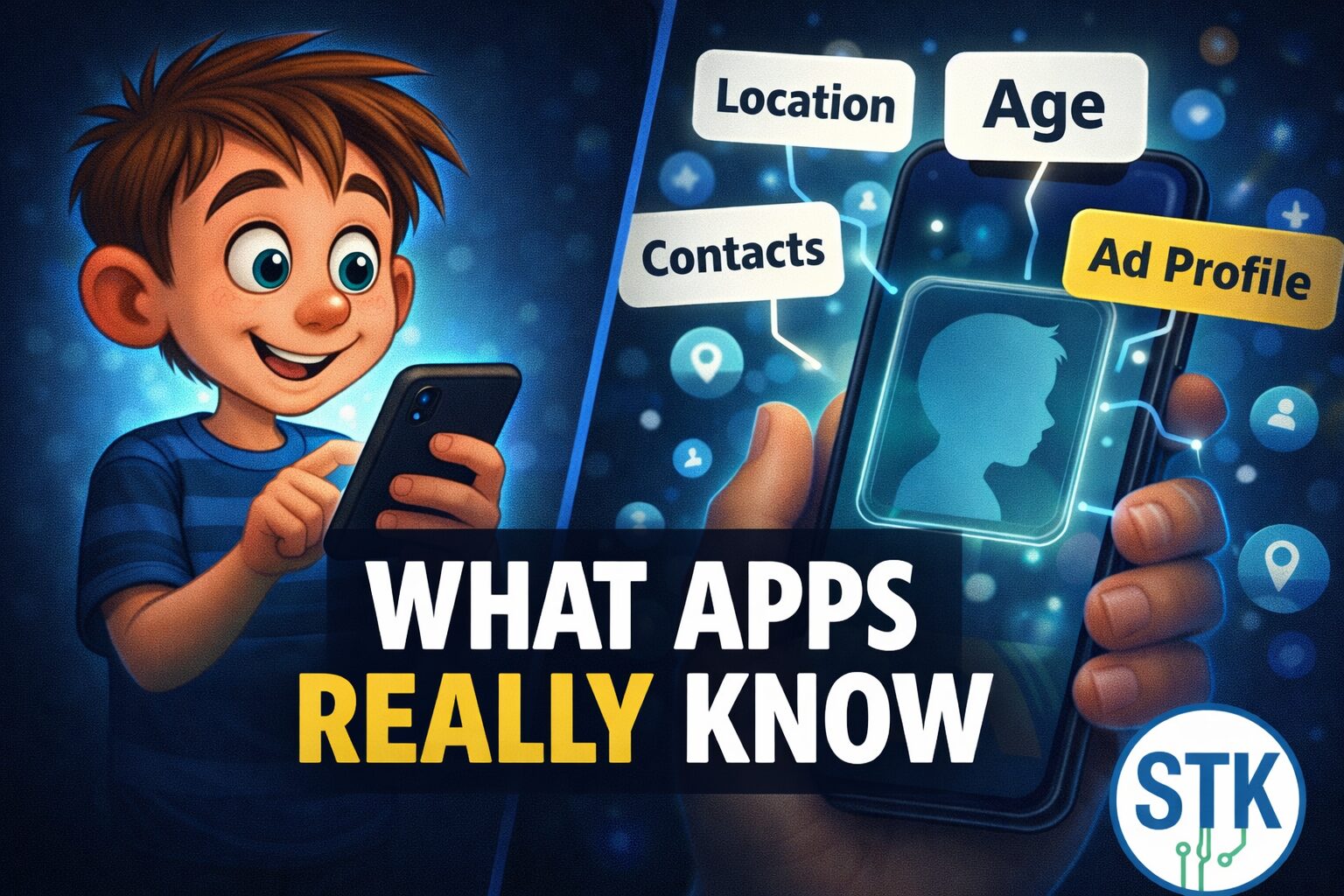
What Every App Knows About Your Child — And Why Your Family’s Data Is Worth Fighting For

Understanding the invisible data economy your children live inside
There is a moment, familiar to most parents, when you hand a phone to a child and feel a vague, unnamed unease. You can’t quite articulate it. The app looks harmless. Your child is happy. Nothing obviously dangerous is happening.
That unease, it turns out, has a name. It’s intuition catching up to a reality most of us haven’t fully examined: that the digital spaces our children inhabit are not neutral playgrounds. They are, in large part, commercial infrastructure — and our children’s attention, behavior, and personal information are the raw material that keeps the whole system running.
This isn’t about panic or cynicism. It’s about understanding the system clearly, because the families who understand it are the ones with real agency inside it.
The Invisible Exchange
Every interaction a child has with an app involves an exchange. The child gets something — a video, a game level, a chat with a friend. The app gets something too, and that something is data.
Some of this data is obvious: name, email address, date of birth. But the more commercially valuable data is behavioral — and it is collected continuously.
Consider what a single session on a popular video platform might collect:
- Which videos were watched to completion and which were skipped
- How long the user paused before making a selection
- What time of day they were active
- Their approximate location
- What device they were using and what other apps shared that device
This information, aggregated across millions of users, allows platforms to build remarkably precise models of individual preference, emotion, and vulnerability.
For children, the picture is even more detailed. Because children’s usage patterns are often more habitual and less varied than adults’, their behavioral data is in some ways more predictable — and therefore more useful to advertisers building long-range targeting models.
Why Children’s Data Commands a Premium
It may seem counterintuitive that a child’s data — from someone with no income and limited purchasing power — would be particularly valuable to advertisers. The explanation lies in the concept of lifetime value.
A child who begins engaging with a platform at age eight is a potential customer for the next sixty or seventy years. The habits, preferences, and brand associations formed in childhood are among the most durable in consumer psychology.
Acquiring data on a young user is, from a commercial perspective, an investment in decades of future influence.
This is why the children’s app market attracts such significant advertising spend, and why the data protection landscape for minors has become a contested regulatory battleground in virtually every major economy.
The Regulatory Picture — And Its Limits
Meaningful protections exist, but they have meaningful limits.
In the United States: The Children’s Online Privacy Protection Act (COPPA), first passed in 1998 and updated in 2013, prohibits the collection of personal data from children under thirteen without verifiable parental consent.
In the United Kingdom: The Age Appropriate Design Code requires platforms likely to be accessed by users under eighteen to build privacy protections into their default settings.
In the European Union: The GDPR includes provisions for children, generally setting the age of digital consent at sixteen, with member states permitted to lower this to thirteen.
These are meaningful protections. But age verification online remains technically difficult and politically contentious. The most common enforcement mechanism — asking users to confirm they are above the minimum age — is trivially circumventable.
The regulatory frameworks are catching up. They are not yet caught up.
Inside the “Free” App Economy
The phrase worth internalizing is this: if the product is free, you are the product.
It’s a cliché in technology criticism — but clichés earn their status by being repeatedly true. Here’s the chain:
- Free apps generate revenue through advertising
- Advertising effectiveness is driven by targeting precision
- Targeting precision requires detailed user data
- User data comes from tracking behavior
The chain is direct and intentional.
What is less widely understood is the degree to which this data flows beyond the app that collects it. Third-party advertising networks, analytics companies, and data brokers all receive fragments of user data through code embedded in apps — sometimes called trackers or SDKs (software development kits).
A single free mobile game may contain ten or more of these embedded trackers. Each one is a conduit for behavioral information flowing outward to companies the user has never heard of.
Research by organizations focused on app transparency has found trackers embedded in apps explicitly marketed for young children — including apps appearing in “educational” and “learning” categories in major app stores.
“Privacy isn’t about having something to hide. It’s about having something to protect.”
David always reminds families: your child’s data today becomes their digital footprint tomorrow. What feels like a harmless game download now can follow them into college applications, job searches, and beyond. The best time to protect their data? Before it’s collected.
What Data Brokers Do With What They Receive
Data brokers are the least visible and least understood part of this ecosystem. Their business is the acquisition, aggregation, and resale of personal information — sourced from apps, websites, loyalty programs, public records, and a wide range of other inputs.
The profiles they build can be extraordinarily detailed: not just basic demographics, but inferred characteristics like household income range, health conditions, relationship status, political leanings, and behavioral tendencies. These profiles are sold to marketers, insurers, employers, and — in some documented cases — individuals with less benign intentions.
For children, the long-term implications of a detailed behavioral profile established in childhood are difficult to predict and nearly impossible to retroactively erase.
Data, once collected and distributed across multiple brokers and buyers, does not disappear. It persists — and it follows the person it describes.
Five Concrete Actions Families Can Take
Understanding the problem is the first step. Acting on that understanding is the second. Here are five meaningful actions — ranked roughly from immediate to ongoing.
1️⃣ Conduct a Permission Audit This Week
Go to your device settings and review what permissions each installed app holds. Look specifically at location, microphone, camera, and contacts. Revoke any permission that doesn’t have an obvious, necessary connection to what the app actually does. This is one of the highest-impact privacy actions available to any user.
2️⃣ Use Privacy Labels Before Downloading
Apple’s App Store and Google Play both display privacy summaries for apps. Before your child downloads something new, spend sixty seconds reviewing what data it collects and whether any of it is linked to their identity. If the disclosure is unusually long or includes categories like “browsing history” or “sensitive info,” investigate further before proceeding.
3️⃣ Turn Off Ad Tracking at the Device Level
On iPhone: Settings → Privacy & Security → Tracking → disable “Allow Apps to Request to Track.”
On Android: Settings → Privacy → Ads → select “Delete advertising ID.”
These settings don’t eliminate data collection entirely, but they significantly reduce the ability of advertisers to build cross-app behavioral profiles.
4️⃣ Choose Paid Over Free for High-Frequency Apps
When a child uses an app daily — for schoolwork, creative expression, communication — consider whether a paid version exists. Paid apps have a fundamentally different revenue model. They don’t need to monetize attention, because the transaction is already complete. The investment in a paid app is often modest relative to the privacy dividend it provides.
5️⃣ Build Data Literacy Into Regular Family Conversation
Audit your own app usage together. Ask your child what they think apps know about them. Explain, in age-appropriate terms, how advertising works and why it needs information to function. Children who understand the underlying mechanics of the digital economy they inhabit are not just better protected — they are better prepared for adult life in a data-driven world.
The Bigger Picture
It’s tempting to frame conversations about children’s data privacy as a problem to be solved by better regulation, or by more responsible technology companies, or by improved parental controls. All of those things matter. Advocacy for stronger legal protections, transparency requirements, and corporate accountability is valuable and necessary.
But at the household level, the most durable protection is educated awareness.
A child who understands that their attention is a commodity — that their habits, preferences, and behavioral patterns have real commercial value, and that surrendering them is a choice rather than a default — is a child equipped to navigate the digital world as a participant, not merely a subject.
Privacy, at its core, is an expression of agency. It is the capacity to determine what you share about yourself, with whom, and under what conditions. Teaching children that this capacity exists, that it matters, and that it is worth exercising is not a technical conversation. It is a values conversation.
And those, fortunately, can happen anywhere — including at the dinner table tonight.

Leave a Reply