
Tag: Child Privacy

  • The Conversation Every Parent Is About to Have

    The Conversation Every Parent Is About to Have – Smart Tech Kids
    πŸ“± Digital Parenting & the Creator Economy

    The Conversation Every Parent Is About to Have

    Smart Tech Kids Β· May 18, 2026 Β· Digital Parenting & Online Safety
    Child watching YouTube on tablet - Kids and the Creator Economy - Smart Tech Kids

    Your kid wants to be a YouTube star. Inside the two biggest kid channels on the internet β€” and what their stories actually mean for the rest of us

    It usually starts with a casual question at the breakfast table. A kid looks up from the iPad, mouth full of cereal, and asks: “Mom, can I have a YouTube channel? My friend Mercedes has one and she makes videos and her mom lets her.”

    For a generation of parents, this is the new “I want to be an actor” β€” except the path looks much shorter, much more accessible, and much more profitable. Your kid has just watched a peer their age open a toy and apparently earn millions of dollars in views and merchandise. Why wouldn’t they want in?

    The honest answer isn’t a flat no, and it isn’t a casual yes. It requires understanding what’s actually happening inside the two channels that have defined this entire genre: Ryan’s World and A for Adley. They look superficially similar β€” child host, parental management, toy reviews, branded merch β€” but their origins, business models, and the truths they reveal about modern childhood are very different.

    And both have lessons for any parent staring across the dinner table at a hopeful little face.

    The Two Origin Stories

    ⚑ Lightning vs. Blueprint

    Ryan’s World began as an accident. In 2015, Loann and Shion Kaji β€” a high school chemistry teacher and a structural engineer β€” started filming their three-year-old son Ryan simply to share with relatives in Japan. No plan, no production company, no strategy. Just a phone camera and a curious toddler asking his mother, “How come I’m not on YouTube when all the other kids are?” Within four months, the videos exploded. Within a year, they were in YouTube’s top 10.

    A for Adley began as a business plan. Shaun McBride β€” already a Forbes 30 Under 30 honoree, a pioneer of Snapchat storytelling, and the founder of a media operation called Spacestation β€” was converting a basement room into a studio before his daughter was born. Adley made her first appearance on his channel at around five months old, in a video that drew 10 million views. She launched her own channel at age two.

    That distinction matters, and most kids miss it entirely. One channel is a story about lightning striking a willing toddler. The other is a story about a media professional doing what media professionals do: building product.

    The Adley your child watches is the daughter of a man who knew exactly how this business worked before she existed.

    Neither path is replicable on demand. One requires luck. The other requires a parent who is already, effectively, a media company.

    The Toy Review Engine β€” And Why It Worked

    Both channels rose on the same fuel: toy unboxing. The reason wasn’t mysterious. By the mid-2010s, parents were already searching YouTube for product demos before buying. Mattel, Hasbro, and Fisher-Price had massive toy lines competing for attention. A real child, opening real toys, with real reactions, created the most powerful possible form of social proof β€” far more persuasive to other children than any TV commercial could ever be.

    So the toy companies came calling. Nintendo, among others, reached out to Ryan’s family about collaborations. The first sponsorship era had begun: channels were reviewing toys while being paid by the companies that made them.

    βš–οΈ When Regulators Noticed

    In August 2019, the FTC and the watchdog Truth in Advertising filed a formal complaint noting that nearly 90% of Ryan’s videos contained at least one paid product recommendation aimed at preschoolers β€” an audience too young to distinguish a commercial from a review.

    To a four-year-old viewer, that distinction was invisible. To regulators, it no longer was.

    The COPPA Earthquake

    The bigger shock came one month later. In September 2019, the FTC fined YouTube $170 million for collecting personal data on viewers under 13 without parental consent. The settlement reshaped the entire kids’ content economy in ways most casual users never noticed.

    πŸ“‹ What Changed for “Made for Kids” Content

    Under the new rules, any video marked “made for kids” immediately lost:

    • Personalized advertising
    • Comments and live chat
    • The notification bell
    • Playlists and the Mini Player
    • Premium CPM ad rates

    For creators, this gutted direct ad revenue overnight. The “kid uploads videos, gets rich on ads” model your child believes still exists… largely no longer does.

    For the Kajis and McBrides, this actually proved their existing strategy was right. Neither family was depending solely on ad revenue anymore. They had already pivoted toward merchandise and licensing β€” income streams COPPA couldn’t touch. For new entrants, though, the landscape had fundamentally changed.

    From Reviewing Mattel to Competing With Mattel

    The most interesting shift in both channels happens after the toy-review phase. Watch carefully and you can see it: they stop being a YouTube channel and start being a brand.

    πŸ“Š The Numbers Behind Ryan’s World

    In 2017, the Kajis signed with PocketWatch, a children’s media startup that took over marketing and merchandise. Ryan’s face went onto products at Walmart and Target. By 2021, Ryan’s World–branded merchandise β€” toothbrushes, bedsheets, monster trucks, paper plates β€” generated more than $250 million in revenue, according to The New York Times. The family founded their own production company, Sunlight Entertainment, with a 30-person team producing about 25 videos a week. By 2024, Ryan’s net worth was estimated to exceed $100 million.

    The transformation is worth restating plainly: the channel that began as a kid reviewing Mattel toys is now in direct competition with Mattel.

    Adley’s trajectory followed the same arc, built on her father’s existing Spacestation infrastructure. Spacestation Labs handles merchandise. The family has launched more than 20 YouTube channels in different languages β€” a globalization move no two-person operation could ever pull off.

    Not everything worked. Ryan’s 2024 feature film Titan Universe Adventure earned just $624,000 on an estimated $10 million budget. Traditional media is a different art form, and the leap doesn’t always land.

    πŸ”Ž CATORI NAKAI β€” The Truth Seeker

    “What you see on screen and what’s actually happening are often two very different things.”

    Catori always reminds kids to ask: Who made this? Why did they make it? What are they not showing me? When your child watches Ryan or Adley, they see a kid having fun with toys. What they don’t see is a production company, a 30-person team, a licensing empire, and a decade of compounding work. Teaching kids to look behind the curtain isn’t cynicism β€” it’s one of the most powerful media literacy skills they can have.

    The Privacy Trade-Off Nobody Likes to Discuss

    This is the hardest part of the conversation, and it’s where most parents need to sit with some discomfort.

    In Ryan’s case, privacy was an afterthought. The family originally used their real surname, Guan, and filmed openly in their home before adopting the on-screen name Kaji. Now 14, Ryan reportedly wants to spend time surfing and hiking, and parts of the YouTube community have started asking pointed questions about whether a teenager can meaningfully opt out of a multi-million-dollar enterprise that was built around him at age three.

    “Whether that’s a real choice for a child who has spent his entire identity-forming years as the face of a global brand is a question without a clean answer.”

    Adley’s family approached privacy more intentionally β€” McBride knew the business β€” but the structural fact remains: she was filmed three weeks after birth, before any concept of consent could exist. From the outside, she looks happy. But the decision was made on her behalf, and it lives on the internet permanently.

    πŸ›οΈ The Labor Law Gap

    Most U.S. states have no meaningful legal protections for child YouTube creators. California’s Coogan Law sets aside a portion of a minor performer’s earnings in trust, and a small number of states (notably Illinois) have begun extending similar rules to child influencers β€” but it remains the exception.

    The default legal reality is that parents own the channel revenue, full stop. Policy is starting to catch up. It hasn’t yet.

    So What Do You Actually Tell Your Kid?

    Here’s the honest answer.

    Your child isn’t imagining “a YouTube channel.” Your child is imagining being Ryan or Adley as they exist today β€” after the production company, the licensing deals, the merchandise empire, the decade of compounding work, and the luck. That version is not on offer to them.

    The version available to them is: most kid channels get a couple hundred views, the economics have been hollowed out by COPPA, and the privacy decisions you make on their behalf are permanent.

    But the impulse β€” wanting to create, to be seen, to make something β€” is healthy. Creativity is the part to honor. Fame and money are the parts to defer.

    🎯 Four Framings That Actually Work

    • Make the videos. Just don’t publish them publicly. A family-only channel, a private cloud folder, an iPad in their room. They can learn the craft without trading away their privacy.
    • If you do publish, treat privacy as a design constraint from day one. First names only. No school uniforms. No house exteriors. No real-time location tells.
    • Decouple the fun from the fame. The actual joy of making something is independent of whether strangers watch it. That distinction is one of the most valuable things a kid can learn early.
    • Build a real off-ramp. If your kid loses interest, the structure of your family shouldn’t punish that decision. Don’t build a business that requires them to keep performing.

    The Bigger Picture

    Ryan’s World and A for Adley are not cautionary tales. They are extraordinary outliers, and the families involved have navigated genuinely difficult terrain with varying degrees of thoughtfulness. They’ve made remarkable amounts of money. They’ve also made permanent decisions on behalf of children who couldn’t consent β€” and those decisions are now permanent features of those children’s lives.

    What your kid is really asking, when they ask to start a channel, is whether they can be seen. That’s an old question, and it predates YouTube by a few decades. The new part is that the answer can now be commercialized at scale, sometimes spectacularly, and almost always at a cost that’s hard to see clearly when you say yes.

    πŸ’‘ The Informed Parent’s Job

    The informed parent’s job isn’t to say no. It’s to make sure the version of yes they say is one their child can still walk away from.
  • What Apps Really Know

    What Apps Really Know

    What Every App Knows About Your Child – Smart Tech Kids
    πŸ” Digital Parenting & Data Privacy

    What Every App Knows About Your Child β€” And Why Your Family’s Data Is Worth Fighting For

    Smart Tech Kids Β· March 15, 2026 Β· Data Privacy & Security
    What Apps Know About Your Child - Smart Tech Kids

    Understanding the invisible data economy your children live inside

    There is a moment, familiar to most parents, when you hand a phone to a child and feel a vague, unnamed unease. You can’t quite articulate it. The app looks harmless. Your child is happy. Nothing obviously dangerous is happening.

    That unease, it turns out, has a name. It’s intuition catching up to a reality most of us haven’t fully examined: that the digital spaces our children inhabit are not neutral playgrounds. They are, in large part, commercial infrastructure β€” and our children’s attention, behavior, and personal information are the raw material that keeps the whole system running.

    This isn’t about panic or cynicism. It’s about understanding the system clearly, because the families who understand it are the ones with real agency inside it.

    The Invisible Exchange

    Every interaction a child has with an app involves an exchange. The child gets something β€” a video, a game level, a chat with a friend. The app gets something too, and that something is data.

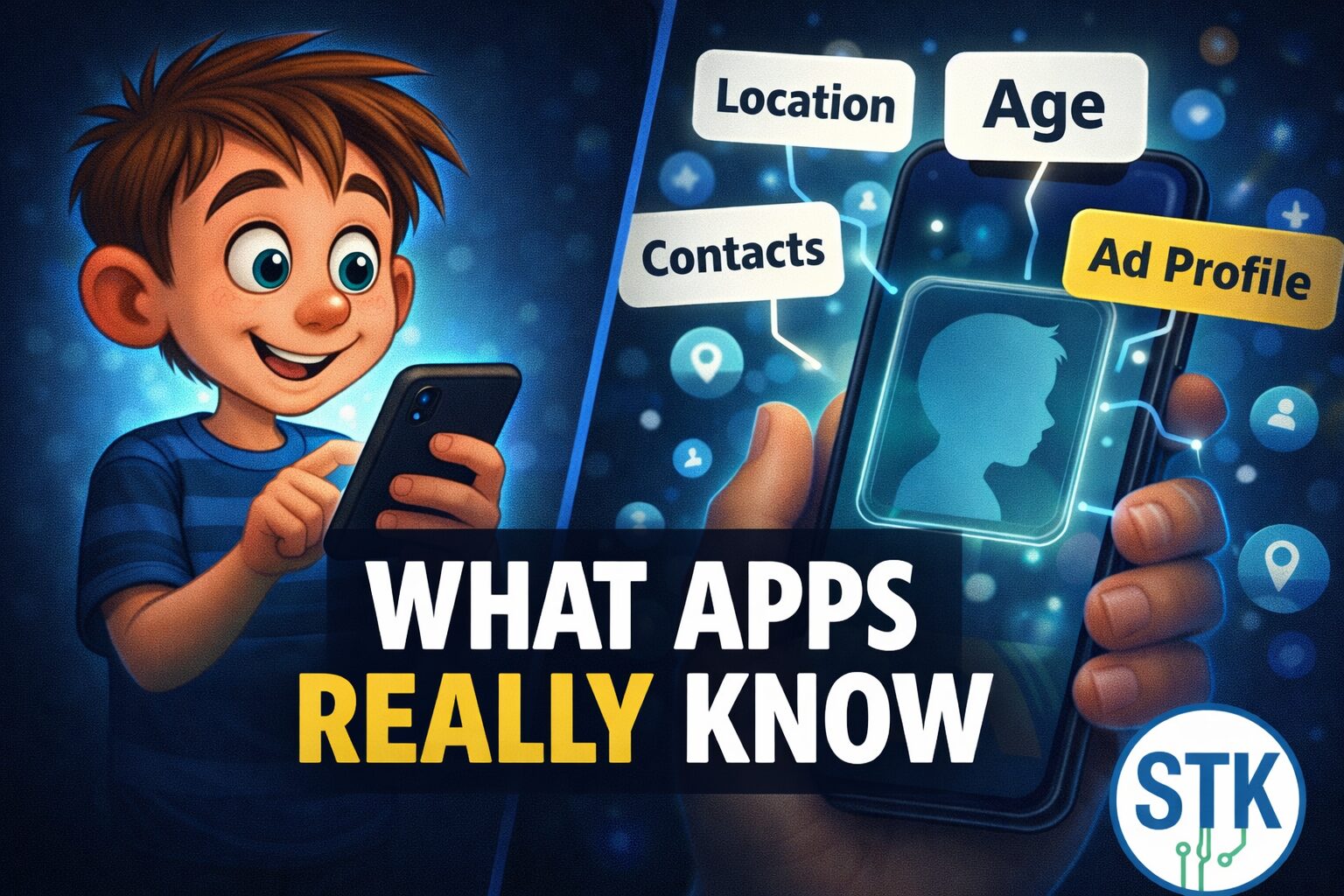
    Some of this data is obvious: name, email address, date of birth. But the more commercially valuable data is behavioral β€” and it is collected continuously.

    What a Single Session Generates

    Consider what a single session on a popular video platform might collect:

    • Which videos were watched to completion and which were skipped
    • How long the user paused before making a selection
    • What time of day they were active
    • Their approximate location
    • What device they were using and what other apps shared that device

    This information, aggregated across millions of users, allows platforms to build remarkably precise models of individual preference, emotion, and vulnerability.

    For children, the picture is even more detailed. Because children’s usage patterns are often more habitual and less varied than adults’, their behavioral data is in some ways more predictable β€” and therefore more useful to advertisers building long-range targeting models.

    Why Children’s Data Commands a Premium

    It may seem counterintuitive that a child’s data β€” from someone with no income and limited purchasing power β€” would be particularly valuable to advertisers. The explanation lies in the concept of lifetime value.

    πŸ’° The 60-Year Customer

    A child who begins engaging with a platform at age eight is a potential customer for the next sixty or seventy years. The habits, preferences, and brand associations formed in childhood are among the most durable in consumer psychology.

    Acquiring data on a young user is, from a commercial perspective, an investment in decades of future influence.

    This is why the children’s app market attracts such significant advertising spend, and why the data protection landscape for minors has become a contested regulatory battleground in virtually every major economy.

    The Regulatory Picture β€” And Its Limits

    Meaningful protections exist, but they have meaningful limits.

    βš–οΈ Current Privacy Laws

    In the United States: The Children’s Online Privacy Protection Act (COPPA), first passed in 1998 and updated in 2013, prohibits the collection of personal data from children under thirteen without verifiable parental consent.

    In the United Kingdom: The Age Appropriate Design Code requires platforms likely to be accessed by users under eighteen to build privacy protections into their default settings.

    In the European Union: The GDPR includes provisions for children, generally setting the age of digital consent at sixteen, with member states permitted to lower this to thirteen.

    These are meaningful protections. But age verification online remains technically difficult and politically contentious. The most common enforcement mechanism β€” asking users to confirm they are above the minimum age β€” is trivially circumventable.

    The regulatory frameworks are catching up. They are not yet caught up.

    Inside the “Free” App Economy

    The phrase worth internalizing is this: if the product is free, you are the product.

    It’s a clichΓ© in technology criticism β€” but clichΓ©s earn their status by being repeatedly true. Here’s the chain:

    • Free apps generate revenue through advertising
    • Advertising effectiveness is driven by targeting precision
    • Targeting precision requires detailed user data
    • User data comes from tracking behavior

    The chain is direct and intentional.

    πŸ“‘ Third-Party Trackers

    What is less widely understood is the degree to which this data flows beyond the app that collects it. Third-party advertising networks, analytics companies, and data brokers all receive fragments of user data through code embedded in apps β€” sometimes called trackers or SDKs (software development kits).

    A single free mobile game may contain ten or more of these embedded trackers. Each one is a conduit for behavioral information flowing outward to companies the user has never heard of.

    Research by organizations focused on app transparency has found trackers embedded in apps explicitly marketed for young children β€” including apps appearing in “educational” and “learning” categories in major app stores.

    πŸ”Ž DAVID COOPER β€” The Security Expert

    “Privacy isn’t about having something to hide. It’s about having something to protect.”

    David always reminds families: your child’s data today becomes their digital footprint tomorrow. What feels like a harmless game download now can follow them into college applications, job searches, and beyond. The best time to protect their data? Before it’s collected.

    What Data Brokers Do With What They Receive

    Data brokers are the least visible and least understood part of this ecosystem. Their business is the acquisition, aggregation, and resale of personal information β€” sourced from apps, websites, loyalty programs, public records, and a wide range of other inputs.

    The profiles they build can be extraordinarily detailed: not just basic demographics, but inferred characteristics like household income range, health conditions, relationship status, political leanings, and behavioral tendencies. These profiles are sold to marketers, insurers, employers, and β€” in some documented cases β€” individuals with less benign intentions.

    For children, the long-term implications of a detailed behavioral profile established in childhood are difficult to predict and nearly impossible to retroactively erase.

    Data, once collected and distributed across multiple brokers and buyers, does not disappear. It persists β€” and it follows the person it describes.

    Five Concrete Actions Families Can Take

    Understanding the problem is the first step. Acting on that understanding is the second. Here are five meaningful actions β€” ranked roughly from immediate to ongoing.

    1️⃣ Conduct a Permission Audit This Week

    Go to your device settings and review what permissions each installed app holds. Look specifically at location, microphone, camera, and contacts. Revoke any permission that doesn’t have an obvious, necessary connection to what the app actually does. This is one of the highest-impact privacy actions available to any user.

    2️⃣ Use Privacy Labels Before Downloading

    Apple’s App Store and Google Play both display privacy summaries for apps. Before your child downloads something new, spend sixty seconds reviewing what data it collects and whether any of it is linked to their identity. If the disclosure is unusually long or includes categories like “browsing history” or “sensitive info,” investigate further before proceeding.

    3️⃣ Turn Off Ad Tracking at the Device Level

    On iPhone: Settings β†’ Privacy & Security β†’ Tracking β†’ disable “Allow Apps to Request to Track.”

    On Android: Settings β†’ Privacy β†’ Ads β†’ select “Delete advertising ID.”

    These settings don’t eliminate data collection entirely, but they significantly reduce the ability of advertisers to build cross-app behavioral profiles.

    4️⃣ Choose Paid Over Free for High-Frequency Apps

    When a child uses an app daily β€” for schoolwork, creative expression, communication β€” consider whether a paid version exists. Paid apps have a fundamentally different revenue model. They don’t need to monetize attention, because the transaction is already complete. The investment in a paid app is often modest relative to the privacy dividend it provides.

    5️⃣ Build Data Literacy Into Regular Family Conversation

    Audit your own app usage together. Ask your child what they think apps know about them. Explain, in age-appropriate terms, how advertising works and why it needs information to function. Children who understand the underlying mechanics of the digital economy they inhabit are not just better protected β€” they are better prepared for adult life in a data-driven world.

    The Bigger Picture

    It’s tempting to frame conversations about children’s data privacy as a problem to be solved by better regulation, or by more responsible technology companies, or by improved parental controls. All of those things matter. Advocacy for stronger legal protections, transparency requirements, and corporate accountability is valuable and necessary.

    But at the household level, the most durable protection is educated awareness.

    🎯 Privacy as Agency

    A child who understands that their attention is a commodity β€” that their habits, preferences, and behavioral patterns have real commercial value, and that surrendering them is a choice rather than a default β€” is a child equipped to navigate the digital world as a participant, not merely a subject.

    Privacy, at its core, is an expression of agency. It is the capacity to determine what you share about yourself, with whom, and under what conditions. Teaching children that this capacity exists, that it matters, and that it is worth exercising is not a technical conversation. It is a values conversation.

    And those, fortunately, can happen anywhere β€” including at the dinner table tonight.