
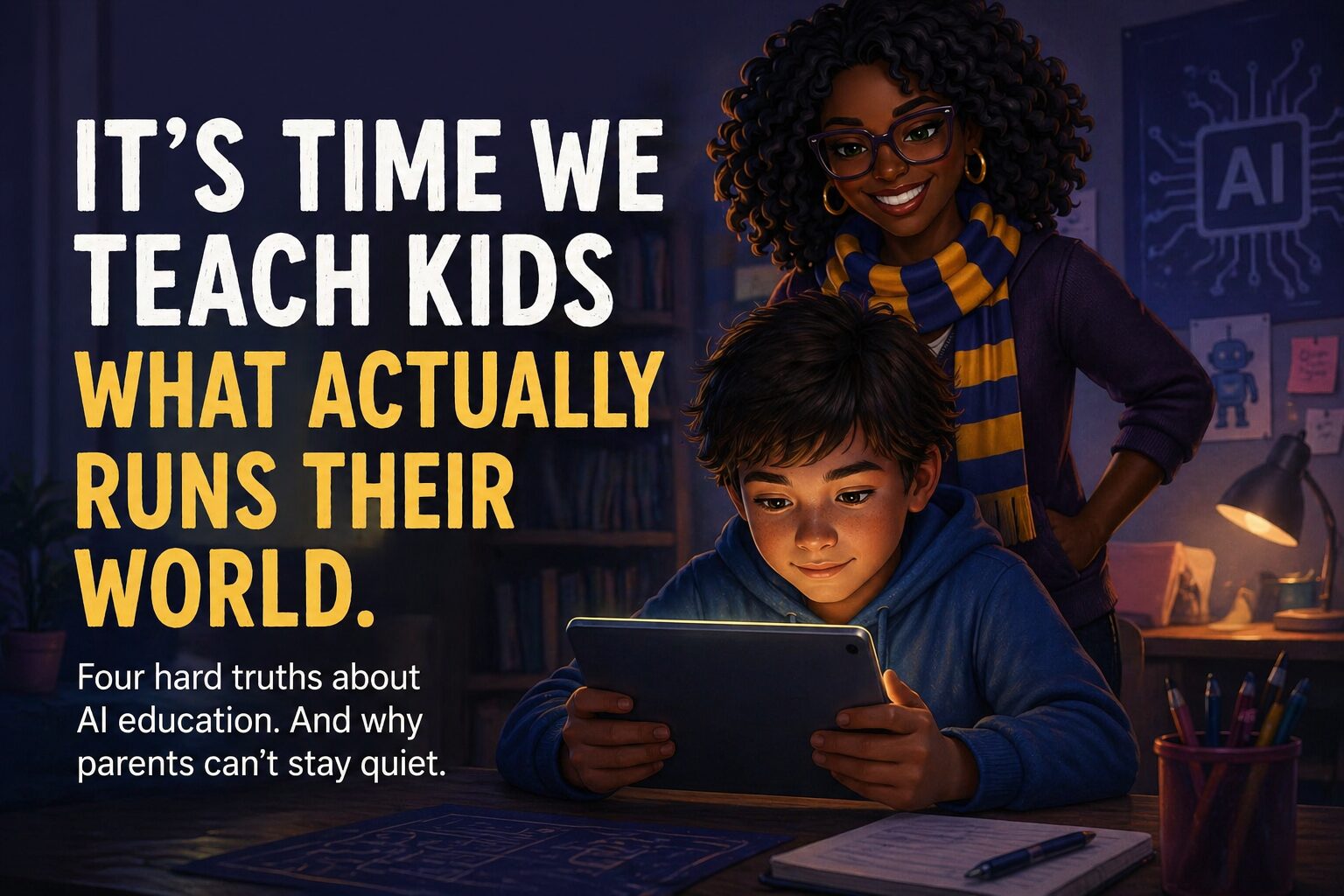
It’s Time We Teach Kids What Actually Runs Their World

It’s past time for a holistic approach to AI education — and as parents, we can’t afford to stay quiet
There’s a quietly growing gap opening up in our schools and for the most part parents don’t know it’s there.
On one side of the gap: the world your child is actually living in, one increasingly shaped, sorted, and decided by artificial intelligence. AI curates what they see online. It influences what colleges or employers might one day notice about them. It powers the tools they’ll be expected to use in virtually every professional field within a decade. AI is no longer ‘coming,’ it arrived on the early train, and it’s been embedded into daily life.
On the other side of the gap: the curriculum most schools are still delivering, largely unchanged in structure, lightly grazing the feet of the AI juggernaut, barely introducing kids to terms that are already outdated. Unsure of whether to even lean into this new technology with so many different opinions on its usefulness, ethical existence and possible environmental threat.
I am not laying blame or criticizing teachers or administrators, not meant to make anyone feel bad. The vast majority of educators are working incredibly hard, often with inadequate resources and shifting expectations. I am talking about a structural challenge. A challenge that requires an honest look at what’s not working and a public conversation about what needs to change.
So let’s have it.
Challenge One: We’re Building the Plane While Flying It
Before we can fix AI education, we have to be honest about one foundational problem: we don’t yet fully know what good AI education looks like.
The research on long-term learning outcomes for AI literacy programs is still emerging. What concepts should be introduced at age seven versus age fourteen? What teaching methods produce lasting understanding versus shallow familiarity? Which approaches actually close opportunity gaps rather than widening them? These are open questions, and they’re not trivial ones.
This isn’t a reason to throw up our hands. Plenty of pioneering educators, researchers, and organizations are doing genuinely thoughtful work to answer these questions. But it does mean that much of what’s being rolled out in classrooms right now is operating without the evidence base that we’d expect for any other major curriculum initiative.
Think about how carefully literacy programs, math frameworks, or science standards are typically evaluated and revised. AI education needs that same institutional rigor, and it needs the funding and political support to build it quickly.
For parents, the concrete ask: advocate for evidence-led curriculum development. When your school district or state board announces an AI program, ask what research it’s grounded in. Ask how outcomes will be measured and reported. These are reasonable questions, they aren’t aggressive questions and asking them signals that parents are paying attention.
Challenge Two: The Textbook Is Always a Step Behind
There’s a huge paradox that anyone working at the intersection of education and technology has had to grapple with: the very nature of AI makes it extraordinarily difficult to teach in traditional institutional settings.
Education systems are built for stability. Curricula are developed over years, piloted, evaluated, approved, and then rolled out. This process can easily take half a decade from concept to classroom.
AI, by contrast, evolves in months. The tools that were cutting-edge when a curriculum was drafted may be genuinely obsolete by the time a student encounters them.
This is more than an inconvenience; it creates a structural mismatch that threatens to make even well-intentioned AI programs feel irrelevant to students almost immediately.
I believe we need to rethink what we’re teaching. The goal shouldn’t be to teach specific AI tools or systems, since those will change. It should be to build durable, foundational understanding:
- How does machine learning work conceptually?
- How is data used and potentially misused?
- How do algorithmic systems make decisions, and what are the ethical dimensions of those decisions?
We shouldn’t abandon structured learning, we need to think through what the foundation looks like and what the pretty flowers in front look like.
These questions remain relevant regardless of which tools or platforms rise or fall. Principles age well. Platforms don’t.
For this to work, curriculum frameworks can’t be locked into the same old five-year review cycles, they must be designed for regular iteration. That requires policy flexibility and funding commitment at both state and national levels. It also requires teachers who feel empowered to adapt and update, rather than rigidly follow a script.
“AI isn’t magic. It’s math, data, and patterns. Once you understand how it works, you can work with it — not just for it.”
Alex teaches kids that understanding the principles behind AI is more powerful than knowing any specific tool. When you understand how machine learning actually works, you can spot its limitations, question its outputs, and use it as a collaborator instead of treating it like an oracle. That understanding doesn’t expire when the next version launches.
Challenge Three: We Can’t Teach What We Don’t Know
Let’s talk directly about the people at the center of all of this: teachers.
The expectation that educators will confidently, meaningfully and smoothly integrate AI into their classrooms in ways that are pedagogically sound is, for many of them, an unfair one. Not because teachers aren’t capable. But because most of them were never taught this themselves.
Professional development in AI is inconsistent at best, nonexistent at worst. Many teachers report feeling underprepared and unsupported when it comes to technology-integrated teaching.
Imagine being asked to coach a sport you’ve never played, in front of students who are already practicing on their own at home. That’s the position many educators are in right now.
The teacher readiness gap isn’t a teacher problem, instead it’s a systemic investment problem. We all know that meaningful professional development takes time, expertise, and sustained funding. It requires ongoing support, and more than a single high level one-day workshop. And it requires treating educators as professionals capable of growing into new domains which we need to give them the time and resources to do so.
For parents and community members, this is a place where advocacy matters enormously. School boards and state legislatures make decisions about professional development budgets. Those decisions are influenced by constituent priorities. When parents make teacher training a visible, vocal priority, it moves up the agenda.
Challenge Four: The Gap That Could Define a Generation
Of all the challenges I’ve discussed so far, I feel like this one carries the most long-term consequence: AI education risks becoming yet another axis along which children’s opportunities are determined by their zip code.
Schools in well-resourced districts are most likely those with larger budgets, stronger technology infrastructure, more staff capacity and are therefore better positioned to develop thoughtful, integrated AI literacy programs. They can afford to bring in specialists, invest in professional development, and pilot new curricula.
Schools in under-resourced communities often can’t. They’re already managing larger class sizes, older equipment, higher rates of teacher turnover, and tighter budgets. And then strap on the strained plastic bag of AI education to the list of things they’re expected to do, no extra time, no extra pay, no real professional prep, i.e., no support.
This is a recipe not for inclusion, but for another new and widening divide.
Fact is the stakes here are significant. If AI literacy becomes a differentiator for college admissions, career opportunities, and civic participation, and based on the current job market, there’s every reason to believe it will, then children who don’t receive it are missing more than just a subject. They’re missing a key to navigating the world they’ll inherit.
Luckily, this is a policy failure we can prevent, but only if we name it directly and address it immediately. Equity in AI education isn’t a “nice to have,” it’s the central moral and economic argument for a national strategy.
That strategy needs to include:
- Targeted investment in under-resourced schools
- Culturally responsive curriculum design
- Community-based approaches to AI literacy beyond the classroom
- Accountability mechanisms that ensure programs actually reach the students who need them most
What Parents Can Do Starting Today
These four challenges — building evidence-based curricula, keeping pace with rapid change, supporting teacher readiness, and ensuring equitable access — are interconnected. Progress on any one requires progress on all.
But here’s what gives me hope: when parents understand what’s at stake, they become powerful advocates for change.
🎯 Concrete Actions for Parents
- Ask questions at school board meetings. What AI curriculum is being used? What research supports it? How are teachers being trained? How will outcomes be measured?
- Support teacher professional development budgets. Make it clear to your district that investing in teacher training is a priority for your family.
- Advocate for equity. Ask how AI education programs will reach all students, especially those in under-resourced schools.
- Fill the gap at home. While we work for systemic change, teach AI literacy at home. Use resources like Smart Tech Kids to build understanding together.
- Connect with other parents. You’re not alone in caring about this. Build community around these questions.
The world our children are inheriting is increasingly shaped by AI. The question isn’t whether they’ll encounter it — they already have. The question is whether they’ll understand it well enough to navigate it with agency, ethics, and opportunity.
That education shouldn’t depend on their zip code. And it can’t wait for the perfect curriculum to emerge. We need to start now, with what we know, while we build what we need.
It’s time we teach kids what actually runs their world.
Join our email list
Get exclusive deals and early access to new products.

0 comments
Leave a comment